 Oldsmar Siding
 Why a Deck in Lutz Has to Work Harder Than One Up North
A deck built the way it's built in Ohio or Pennsylvania has a short lifespan once it lands in west-central Florida. Homes around Lutz deal with a combination that most of the country never sees at once: hurricane-force wind gusts during the summer and fall storm season, sun exposure strong enough to break down finishes and plastics that were never tested for it, sudden wind-driven rain that gets pushed sideways under railings and through gaps most decks aren't detailed to handle, and salt-tinged air that rides in on Gulf breezes from Tampa Bay and works its way into every piece of exposed metal on a structure. None of these is dramatic on its own. Together, over a few Florida summers, they're what turns a deck that looked fine at the one-year mark into a project that needs rebuilding at year five.
A correctly built deck in this area isn't a different-looking deck — it's the same deck built with different assumptions. The lumber, the fasteners, the flashing, the footing depth, and the railing hardware all get chosen for a climate that never really lets a structure dry out and rest, and that occasionally throws 100-plus mph wind at it.
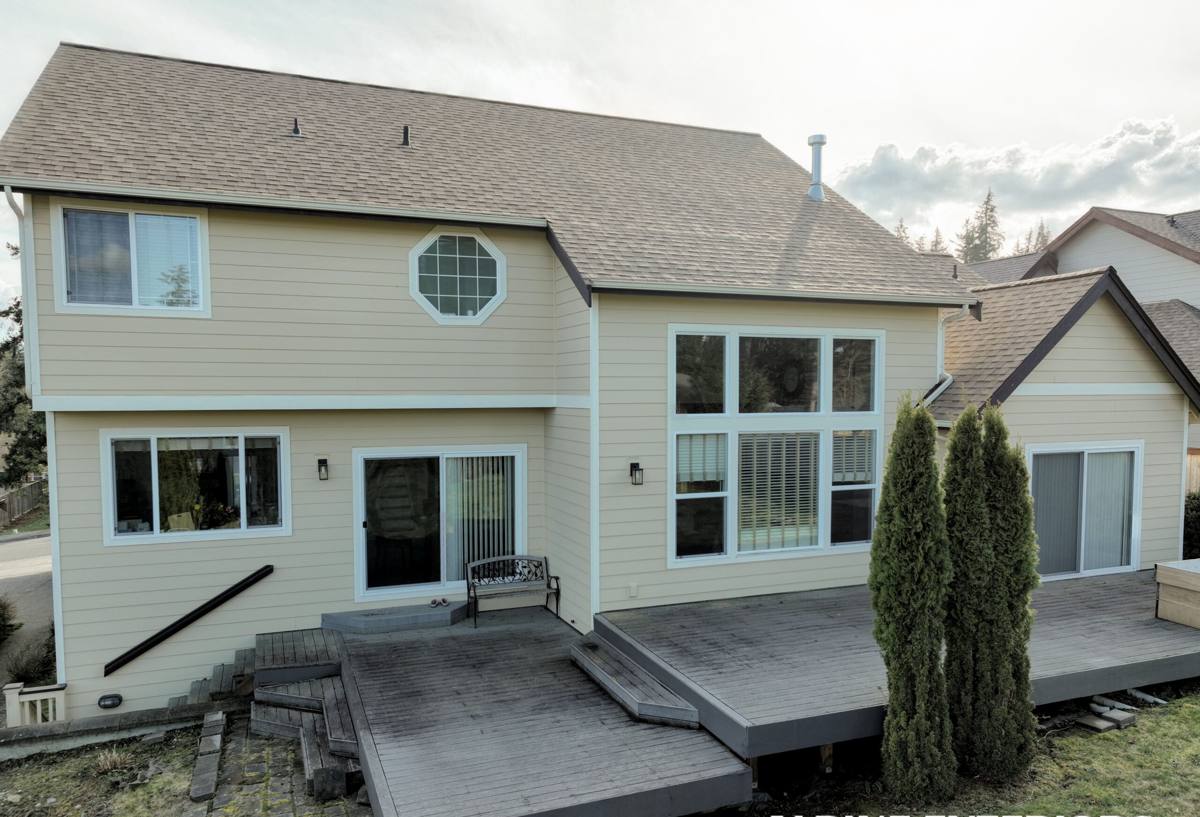
What "Custom" Should Actually Mean for a Lutz Property
"Custom" gets used loosely in this trade. For us it means the deck is designed around your actual lot and how you use it — not pulled from a generic template and resized. Lutz has a mix of lot styles: some properties sit under heavy tree canopy with a lot of afternoon shade, others are more open with full sun most of the day. Both conditions change what a deck needs.
Shaded, tree-covered lots hold moisture longer after rain, collect leaf litter and pollen in the deck boards' grooves, and grow algae and mildew faster on the surface. That points toward decking with a tighter, less porous surface and a layout with enough gap and airflow underneath to let things dry out between storms. Open, sun-exposed lots put more stress on finishes, fade colors faster, and heat surfaces enough that material choice affects how comfortable the deck actually is to walk on barefoot in July. A custom design accounts for which situation your yard actually falls into, plus how the deck ties into your home's grade, drainage, pool equipment, or existing patio — instead of assuming one layout fits every yard in the area.
Choosing a Decking Material That Won't Fight the Climate
This is the decision that determines how much work the deck asks of you for the next 15-20 years. There's no single "best" material — it's a real set of trade-offs, and we'll walk through them honestly rather than push whatever has the best margin.
| Material | How it handles FL sun & humidity | Maintenance | Typical lifespan here |
|---|---|---|---|
| Pressure-treated pine | Prone to checking/cupping under intense UV; needs sealing to resist moisture cycling | Annual cleaning + re-sealing every 1-2 years | 10-15 years with upkeep |
| Tropical hardwood (ipe, cumaru) | Naturally dense and rot-resistant; still grays and needs oiling to hold color in strong sun | Oiling 1-2x/year if you want to keep the color | 25+ years structurally |
| Capped composite (Trex, TimberTech, etc.) | Resists moisture and insects well; cap layer holds up to UV better than early composite generations | Occasional soap-and-water washing | 20-30 years, mfr. warranty-backed |
| PVC decking | Fully synthetic, doesn't absorb water — best option for shaded, damp, tree-covered lots | Lowest maintenance of the group | 25-30 years |
| Uncapped/early-generation composite | Older formulations can absorb moisture and stain in humid, shaded conditions | More maintenance-sensitive than capped composite | Shorter than capped composite |
For most Lutz-area jobs we lean toward capped composite or PVC, especially on shaded lots, because they hold up to humidity cycling without the sealing schedule wood demands. Real hardwood and quality pressure-treated lumber still have a place — they're the right call when the homeowner wants the natural wood look and is willing to keep up with oiling. The wrong call is putting an uncapped or budget composite board in a heavily shaded, wet spot and expecting it to perform like the premium version — that's a maintenance headache we'd rather steer you away from up front.
Railings and Trim
Railings take the most direct sun and rain exposure on the whole structure, and they're also a structural safety item, not just decoration. Aluminum and PVC/composite railing systems generally outperform wood here — they don't need repainting, they don't crack under UV, and they don't telegraph moisture damage the way a painted wood rail cap does after a couple of Florida wet seasons.
The Structure Underneath Is Where Decks Actually Fail
Almost every deck failure we get called out for isn't a surface problem — the boards usually look fine. It's the framing, fasteners, and connections underneath that gave out first, and by the time it shows on the surface it's already a structural issue.
Footings and Framing
Footing depth and post spacing need to account for Florida's wind uplift requirements, not just the deck's static weight. That means proper concrete footings sized for the structure, joists spaced to the load and species of decking used, and hurricane ties or structural screws at key connections instead of relying on nails alone. The ledger board — where the deck attaches to the house — is one of the most common failure points nationally, and it needs correct flashing so wind-driven rain can't work its way behind it and rot the house's rim joist from the inside out.
Fasteners and Hardware
| Hardware type | Performance in humid/salt-influenced air |
|---|---|
| Standard electro-galvanized fasteners | Corrode fastest; not appropriate for exterior Florida use |
| Hot-dip galvanized fasteners | Solid mid-range option for framing not in direct salt exposure |
| Stainless steel fasteners | Best corrosion resistance; standard for ledger boards, railing posts, and hidden fastener systems on our jobs |
| Coated composite-rated screws | Required to avoid reacting with certain composite/PVC board chemistries |
Mismatching fasteners to the decking material is a common shortcut that causes staining, corrosion streaks, and weakened connections well before the boards themselves wear out. We match hardware to material and exposure, not just to whatever's cheapest by the box.
Permits and Code Requirements
Deck construction in this area is permitted work, not a weekend add-on — and for good reason, since a poorly built deck attached to a house is a real safety liability in wind events. Depending on size, height, and whether the deck attaches to the house, you're typically looking at a building permit through the local jurisdiction, an inspection process, and code requirements around railing height (generally 36-42 inches depending on deck height), baluster spacing (no gap wide enough for a 4-inch sphere to pass), stair geometry, and structural connection details. We handle the permitting and inspection process as part of the build so you're not the one chasing down approvals or discovering a problem at final inspection.
Our Process, Start to Finish
- Site visit and design conversation. We walk the property, talk through how you'll actually use the space, and look at drainage, grade, sun/shade exposure, and how the deck ties into the house.
- Material and layout selection. We go through the honest trade-offs above so you're picking a material based on how your specific lot behaves, not a showroom sample.
- Written estimate. Clear scope, materials, and pricing before anything is signed.
- Permitting. We prepare and submit what the local building department requires and schedule inspections around the build.
- Construction. Footings and framing first — this is the stage that determines whether the deck survives its first real storm season — then decking, railing, and trim.
- Final walkthrough and inspection sign-off. We go over the finished deck with you and make sure the permit closes out clean.
Living With a Florida Deck: What Actually Keeps It Looking Right
Every decking material still needs some upkeep — the difference is how much and how often. Here's a realistic checklist for keeping a deck in the Lutz/Oldsmar climate performing the way it should:
- Rinse or wash the surface every few months to clear pollen, tree debris, and the algae film humid, shaded areas tend to grow
- Check railing posts and stair connections once a year for looseness — wind load works on these joints constantly
- Keep gutters and downspouts clear so runoff isn't dumping extra water onto or under the deck
- Re-oil natural hardwood or seal pressure-treated lumber on the schedule the material actually needs, not "whenever it looks bad"
- Look underneath the deck after major storms for standing water, debris buildup against posts, or any sign of ledger board separation from the house
- Trim back tree limbs and vegetation that keep sections of the deck shaded and damp longer than the rest
Why a Crew That Already Works Around Lutz Matters
Building codes, wind load requirements, and inspection expectations vary by jurisdiction, and a crew that's already pulled permits and passed inspections in this part of Pinellas County isn't guessing at what the inspector will want to see. We also know what actually happens to decks here after a few years — which materials hold up under real tree cover, which fastener choices cause problems, which layouts drain properly after a fast summer storm — because we've gone back and looked at our own work and other decks in the area that weren't built with this climate in mind. That local track record is worth more than a lower bid from a crew building the same deck they'd build in a dry, mild climate somewhere else.
If you're weighing a new deck for a Lutz-area property, we're happy to come take a look, talk through what your specific lot needs, and put together a straightforward, no-pressure estimate — just fill out the form below.