 Oldsmar Siding
 Siding Built for the Countryside Climate, Not Just the Countryside Look
Homes in the Countryside area near Oldsmar sit in one of the more demanding exterior environments in the country. You're close enough to Tampa Bay and the Gulf to get salt-laden air on a regular breeze, far enough into Pinellas County's dense tree canopy and afternoon storm cells to take wind-driven rain broadside for months at a time, and under a sun that delivers close to year-round UV exposure with almost no offseason for a siding product to recover. Add hurricane-season wind loads to that mix and you have a set of conditions that will find every weakness in a siding system within a few years, not a few decades.
That's the lens we use when we talk about siding for this neighborhood. It isn't a generic conversation about colors and curb appeal — it's a conversation about what a wall assembly has to survive here, season after season, without curling, cracking, delaminating, or feeding moisture into the wall behind it. Fiber cement, installed correctly, is one of the few claddings that holds up to that combination. This page covers what that actually means for a Countryside-area home: what the climate does to ordinary siding, what a correct fiber cement installation involves, and why the company doing the work matters as much as the product itself.
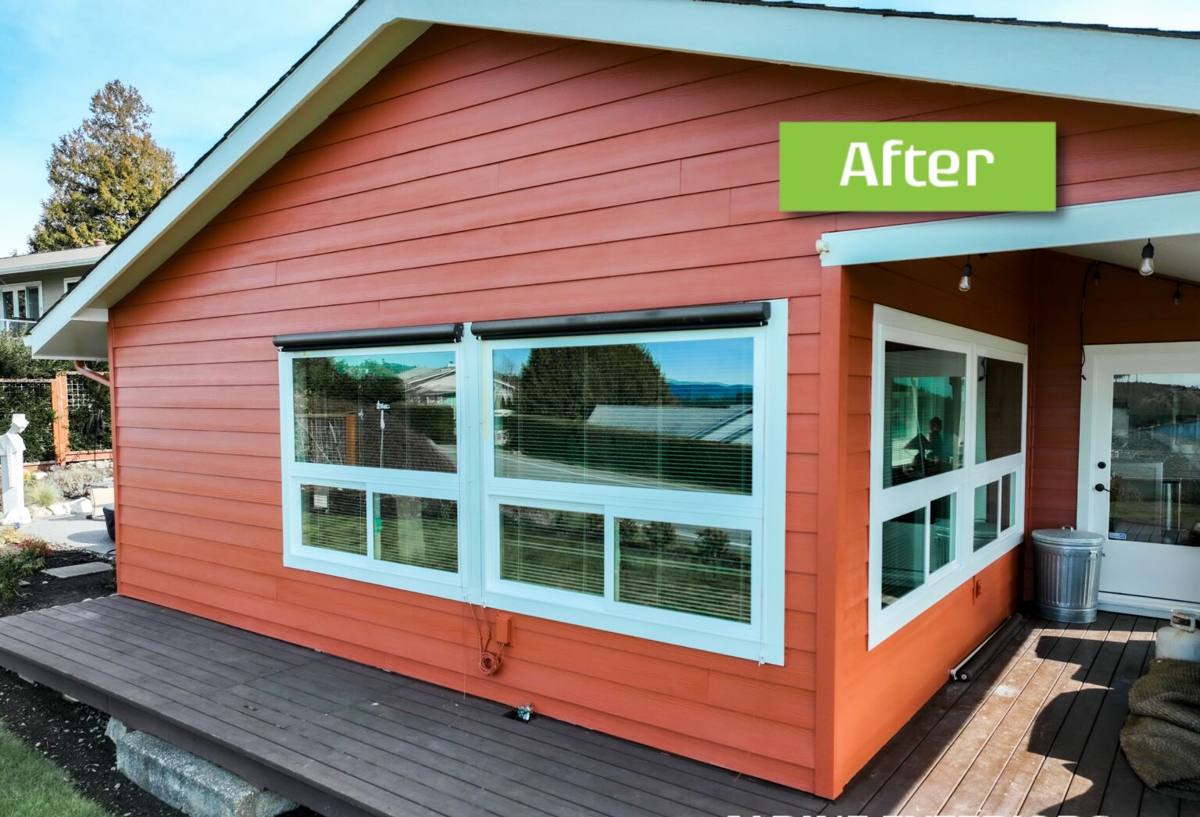
What Heat, Salt Air, and Storm Wind Actually Do to a House
UV and Heat Cycling
Pinellas County sun is intense for most of the year, and exterior surfaces here go through daily heat-up and cool-down cycles that are more extreme than what siding manufacturers assume in cooler climates. Paint film on wood or engineered wood products chalks, fades, and eventually cracks as the substrate beneath it expands and contracts. Vinyl siding can warp or distort in high heat, especially on south- and west-facing walls that catch direct afternoon sun.
Wind-Driven Rain
Florida thunderstorms don't just drop rain — they push it sideways into lap joints, corner boards, and anywhere a siding system relies on gravity alone to shed water. Any product with exposed seams, absorbent edges, or a moisture-sensitive core is at a disadvantage. Over time, wind-driven rain finds the gaps a calmer climate would never expose.
Salt Air
You don't have to be beachfront to feel the effects of salt air near Tampa Bay. Airborne salt accelerates corrosion of fasteners and trim hardware and speeds up the breakdown of coatings that aren't formulated to resist it. Over years, that shows up as premature fastener staining, coating failure, and — on lower-quality products — surface degradation that starts well before the siding is "old."
Hurricane-Force Wind
Every siding product sold in Florida claims a wind rating, but the number on a spec sheet only means something if the installation matches it — correct fastener type, spacing, and embedment; correct handling of corners and edges, which see the highest uplift pressure; and correct integration with house wrap and flashing so wind-driven rain doesn't get pushed behind the panel during the storm that tests it.
Why We Install Only James Hardie Fiber Cement
We made a deliberate decision to install James Hardie fiber cement siding exclusively — not LP SmartSide, not vinyl, not Cemplank, not Allura, not primed spruce or cedar. That's not a marketing position; it's a standard we hold because of what we've seen happen to other products in exactly this climate.
Fiber cement is non-combustible and dimensionally stable in a way that engineered wood and vinyl simply aren't — it doesn't expand and contract with humidity the way wood-based products do, and it doesn't soften or distort in high heat the way vinyl can. James Hardie's HZ product lines are engineered specifically for humid, high-UV climates like ours, and the factory-applied ColorPlus finish is baked on and warrantied against fading and cracking in a way field-applied paint can't match. That combination — a stable substrate plus a factory finish designed for this exact climate — is why we standardized on it rather than offering a menu of cheaper alternatives.
We're not going to tell you other products are junk. LP SmartSide, vinyl, and the rest all have legitimate uses and loyal installers. What we will say is that after years of doing exterior work in Pinellas County, the trade-offs on those products — moisture sensitivity, heat distortion, field-applied finishes that need repainting, warranty structures that don't hold up as well in coastal-influenced air — aren't trade-offs we're willing to put our name behind on a Countryside-area home.
What a Correct Fiber Cement Installation Actually Involves
The siding material is only part of the equation. Most premature siding failures we see aren't a product problem — they're an installation problem. A correct job for this climate involves several steps that are easy to skip and impossible to verify once the wall is closed up.
Tear-Off and Substrate Inspection
Old siding comes off and the sheathing underneath gets inspected before anything new goes up. In a humid climate, hidden moisture damage behind old siding is common, and covering it up with new material instead of repairing it just resets the clock on the same failure.
Weather-Resistive Barrier and Flashing
A correctly lapped house wrap, properly integrated window and door flashing, and correct kick-out flashing at roof-wall intersections are what actually keep wind-driven rain out of the wall assembly. The siding is the outer layer of a system — it's not the whole system.
Fastening to Spec
James Hardie publishes specific fastener types, spacing, and embedment requirements for Florida's wind zones. Corners and edges need tighter fastener spacing because that's where uplift pressure concentrates during high wind. Using the wrong fastener or spacing pattern can void the manufacturer warranty even if the product itself is correct.
Joint and Butt Seam Treatment
Butt joints, corners, and penetrations (hose bibs, light fixtures, vents) are where water intrusion starts on almost every siding job, good or bad. Correct caulking, proper joint flashing, and attention to manufacturer-specified gaps at these transitions matter more than almost anything else on the job.
Ventilation and Rainscreen Considerations
On many homes, a small air gap behind the siding (a rainscreen) helps the wall assembly dry out after it gets wet — which, in this climate, it will. Where it's appropriate for the wall assembly, we account for this rather than installing siding tight against a wet-prone substrate.
| Factor | Why It Matters in Countryside / Oldsmar |
|---|---|
| Wind rating vs. installed wind performance | A product's spec-sheet rating only holds if fastener spacing and corner detailing were done to spec |
| Moisture-resistant core | Wind-driven rain during Gulf-side storms tests every seam and joint, not just the field of the wall |
| Factory-cured finish vs. field-applied paint | UV and heat cycling break down field paint faster than a factory-baked finish |
| Fastener and hardware corrosion resistance | Salt-influenced air accelerates corrosion on lower-grade hardware over years, not decades |
| Substrate stability in heat and humidity | Dimensionally unstable substrates expand, contract, and eventually show joint and paint failure |
How Our Process Works, Start to Finish
For a Countryside-area project, the process generally looks like this: an on-site evaluation where we walk the exterior, check the current siding and substrate condition, and talk through what the home actually needs; a written proposal that spells out the Hardie product line, color, and scope rather than a vague allowance; permitting through the appropriate Pinellas County or municipal process, since siding replacement in this area typically requires a permit; the tear-off and substrate repair phase; the weather barrier and flashing work described above; the Hardie installation itself, fastened and jointed to manufacturer spec for our wind zone; and a final walkthrough where we go over the finished work with you before calling the job complete.
We also account for practical realities specific to homes in established Pinellas County neighborhoods — mature landscaping close to the house, HOA exterior-color guidelines where they apply, and coordinating around neighbors' property lines and shared fence lines. None of that is complicated, but it's the kind of local familiarity that comes from working in these neighborhoods repeatedly rather than showing up once.
Maintenance: What Countryside Homeowners Should Actually Expect
One of the real advantages of James Hardie fiber cement in this climate is how little ongoing maintenance it demands compared to wood-based or vinyl alternatives. That said, "low maintenance" isn't "no maintenance," and knowing what to check keeps small issues from becoming expensive ones.
- Rinse the exterior periodically to remove salt residue and airborne grime, especially on sides facing prevailing wind
- Inspect caulking at joints, corners, and penetrations annually and before hurricane season
- Watch for any staining around fasteners, which can indicate a hardware issue worth addressing early
- Keep sprinkler heads and irrigation aimed away from the base of the siding to avoid constant wetting at the bottom course
- Trim vegetation back from the siding so leaves and branches aren't holding moisture against the surface
- Have flashing and kick-out details at roof-wall intersections checked during any roof work, since that's a common point where two trades' work meets
What Affects the Cost of a Fiber Cement Siding Project
We don't publish blanket prices because every home is different, but a few factors consistently drive cost on projects like this: the amount of substrate repair needed once old siding comes off (which you can't fully know until tear-off begins), the complexity of the home's trim, corners, and rooflines, the Hardie product line and color selected, and the scope — full replacement versus a partial or accent application. A detailed, written estimate after an on-site evaluation is the only way to get numbers you can actually plan around.
Why Hiring a Crew That Already Works in Countryside Matters
Fiber cement siding is not a forgiving product for a first-time or out-of-town crew to learn on. It's heavier than vinyl, it requires different cutting and fastening techniques, and the manufacturer's warranty depends on installation being done to spec — details a crew unfamiliar with Hardie or unfamiliar with Florida wind-zone requirements can easily get wrong without it being obvious until years later. A crew that's installed Hardie repeatedly in Pinellas County neighborhoods like Countryside already knows the local permitting process, has already seen how these homes' substrates hold up under our humidity, and has already worked through the wind-zone fastening details that matter here. That experience shows up in the parts of the job you can't see once it's finished — the flashing behind the corner boards, the fastener pattern at the wall edges, the joint treatment at every seam — which is exactly where the difference between a siding job that lasts and one that doesn't gets decided.
If you're weighing a siding replacement for a home in the Countryside area, we're happy to walk the exterior with you, look at what your current siding and substrate are telling us, and put together a straightforward, no-pressure estimate for James Hardie fiber cement done right. There's a form below — reach out and we'll set up a time to take a look.