 Oldsmar Siding
 Composite Decking Built for What Lutz Weather Actually Does
A deck in the Tampa Bay area doesn't fail the way a deck fails in a milder climate. It fails because the sun is nearly overhead for months at a time, because afternoon storms drive rain sideways under railings and through seams, and because the air itself carries enough moisture and salt to work on fasteners and framing year-round. Homeowners in Lutz are asking for composite decking specifically because they've already seen what that combination does to a wood deck that isn't maintained on a strict schedule, or to a lower-grade composite board that wasn't rated for real Florida sun.
This page covers what a composite deck actually needs to hold up here, what a correct installation looks like from the ground up, and how we approach the job when we build one in Lutz.
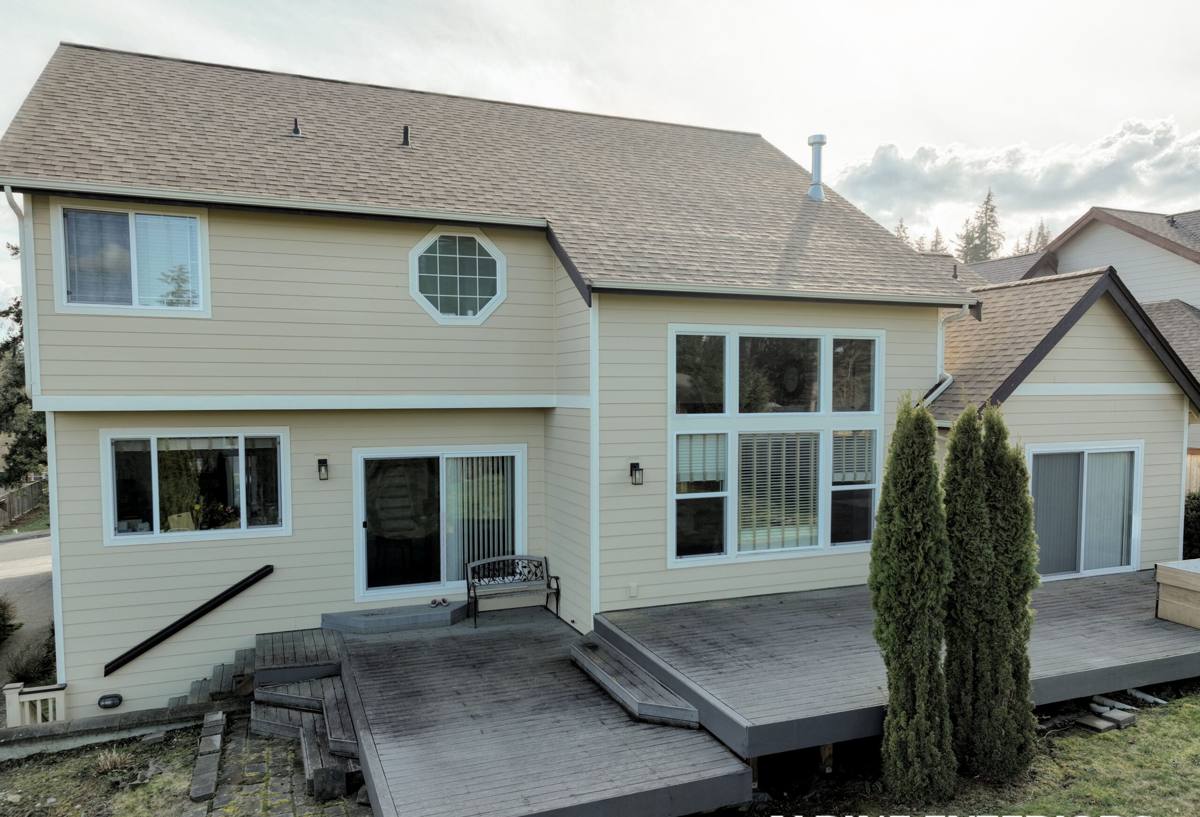
What Pinellas and Hillsborough Weather Does to Outdoor Decking
UV and Heat
Direct, high-angle sun for most of the year fades color and breaks down surface fibers faster than it does in northern climates. Cheaper composite boards without real UV inhibitors in the cap layer will chalk, fade unevenly, or go brittle at the surface well before their rated lifespan. Board temperature also matters for comfort — darker, uncapped composite can get hot enough underfoot in July that material choice becomes a livability issue, not just a durability one.
Wind-Driven Rain
Storms here rarely fall straight down. Wind pushes rain under railings, into ledger connections, and into any gap in the decking surface where water can pool instead of shed. A deck built without proper slope, flashing, and drainage will trap water in exactly the spots where rot and fastener corrosion start — usually the framing underneath, not the decking boards people can see.
Humidity and Salt Air
Even away from the immediate coastline, this region's humidity keeps wood moisture content elevated for long stretches, which is what invites fungal decay and termite activity in untreated framing. Homes closer to open water pick up airborne salt on top of that, which accelerates corrosion on any fastener, bracket, or connector that isn't rated for it.
Composite vs. Wood vs. PVC: What We Recommend and Why
We install composite decking as our standard recommendation for most Lutz homeowners because it holds up to this specific mix of sun, rain, and humidity with the least ongoing maintenance. That said, every material has trade-offs, and we'll walk through them honestly rather than push one product.
| Material | Upfront Cost | Heat & UV Behavior | Moisture / Rot Resistance | Maintenance |
|---|---|---|---|---|
| Pressure-Treated Wood | Lowest | Fades, checks, and splinters with sun exposure | Requires sealing on a regular schedule to resist rot | Annual cleaning, sealing, and board inspection |
| Composite (capped) | Mid to upper-mid | Resists fading and surface breakdown with UV-stable cap layers | Does not rot; resists moisture absorption | Periodic washing; no sealing or staining |
| PVC / Vinyl Decking | Highest | Very stable in sun, but can show more surface heat and flex in high temperatures | Fully moisture-resistant | Low; occasional washing |
For most projects, capped composite gives Lutz homeowners the best balance: it doesn't demand the yearly upkeep wood does, and it costs less than full PVC systems while offering similar resistance to rot and moisture. Where a client wants the lightest possible maintenance and budget allows for it, PVC is a reasonable alternative — we'll discuss both honestly rather than steer you toward the higher-margin option.
What a Correct Composite Deck Installation Actually Involves
The decking boards get the attention because they're what you see and stand on, but most deck failures we get called to inspect trace back to the structure underneath, not the boards themselves. A correct installation addresses all of the following, not just the visible surface.
Framing and Substructure
Joists, beams, and posts need to be sized and spaced for the actual span and load, not just "close enough." In a climate with this much moisture exposure, we favor framing materials and fasteners rated for ground contact and coastal-grade corrosion resistance, even on decks that aren't waterfront.
Ledger Attachment and Flashing
Where a deck attaches to the house, the ledger board and its flashing are the single most common point of hidden water intrusion. Done wrong, wind-driven rain works its way behind the flashing and into the house's rim joist or sheathing — a problem that can go unnoticed for years before it shows up as rot or interior damage.
Fastening System
We use hidden fastener systems designed for the specific composite product being installed, not universal clips that may not account for the board's expansion and contraction in Florida's temperature swings. Composite boards move seasonally with heat; gaps and fastener spacing have to account for that movement or boards will buckle or gap unevenly.
Drainage and Grading
Decking boards need consistent spacing and slope so water sheds off the surface instead of pooling, and the ground or structure underneath needs a way for that water to keep moving away from the house. This matters more here than in drier climates, where a deck can tolerate sloppier drainage without consequence.
Permitting and Code
Deck construction in this area falls under local building code for footing depth, railing height, guard spacing, and structural attachment. We pull the required permits and build to code rather than treat it as optional — it protects you at resale and, more immediately, it's what keeps the structure safe under real wind and foot-traffic loads.
Our Process, Start to Finish
- On-site assessment: We look at the attachment point to your home, existing grade and drainage, sun exposure, and any structural issues if we're replacing an old deck.
- Material and layout discussion: We go over composite product options, color and board profile, railing style, and layout — including where code requires guards or stairs.
- Written estimate: A clear scope and price before any work starts, no vague allowances.
- Permitting: We handle the permit application and required inspections so you don't have to chase paperwork.
- Demolition (if replacing): Old decking and, where needed, old framing are removed and hauled off.
- Framing and structural work: Posts, beams, joists, and ledger attachment are built to span and load requirements, with corrosion-resistant hardware throughout.
- Decking installation: Boards are installed with proper spacing, fastening, and drainage slope.
- Railing and finish work: Railings, stairs, fascia, and trim are completed to match the chosen system.
- Final walkthrough: We review the finished deck with you and cover basic care before we consider the job done.
Design Considerations Specific to This Area
Sun Orientation
Deck orientation relative to the house affects both comfort and material behavior. A west- or south-facing deck in Lutz sees more direct afternoon sun, which means board color choice (lighter colors run cooler underfoot) and any planned shade structure matter more than they would on a north-facing deck.
Pool-Adjacent Decking
Many homes in this area pair decking with a pool area. Decking near a pool sees more standing water, more sunscreen and chemical exposure, and needs slip resistance factored into board selection — not every composite profile is a good fit next to water.
Railings and Code Compliance
Guard height and baluster spacing are dictated by code, not just style preference. We build railings that meet code first and match your aesthetic second, since a railing that looks right but doesn't meet spacing requirements is a liability at inspection and at resale.
Ventilation Underneath
Low-clearance decks need enough airflow underneath to keep the substructure from staying damp between rain events. In a humid climate, a deck built too close to grade without ventilation is inviting the same moisture problems composite decking is supposed to solve.
Maintenance: What Composite Decking Needs Here (and What It Doesn't)
Composite decking's main appeal is how little upkeep it needs compared to wood, but "low maintenance" isn't "no maintenance," especially in this climate.
- Wash the surface periodically to remove pollen, dirt, and organic buildup that can support mold or mildew growth in humid conditions.
- Check railing connections and fasteners once or twice a year, since even coastal-rated hardware benefits from a visual check.
- Keep gutters and downspouts near the deck clear so water isn't dumping directly onto or under the structure.
- Trim back landscaping that shades the deck constantly, since boards that never fully dry out are more prone to surface mildew.
- Inspect the ledger flashing area annually — it's the spot most likely to develop a hidden leak, and it's easy to check from underneath.
What composite decking doesn't need is annual sanding, staining, or sealing. That's the trade-off homeowners are usually making the switch for, and it holds up as long as the underlying installation was done correctly in the first place.
What Actually Drives the Cost of a Composite Deck
We don't publish flat per-square-foot pricing because the honest answer is that cost depends on several factors specific to your property. What we can do is walk through what moves the number up or down.
- Deck size and shape: Square footage is the baseline driver, but complex shapes with angles, cutouts, or multiple levels add labor beyond simple square-footage math.
- Height off grade: A deck requiring stairs, taller posts, or additional structural bracing costs more than a low, ground-level deck.
- Composite product tier: Board lines vary in cap technology, color options, and warranty terms, which affects material cost per board.
- Railing style: Composite and aluminum railing systems cost more than basic options, and glass or cable railings add further cost.
- Site access and demolition: Removing an old deck, dealing with limited access, or working around existing landscaping adds labor time.
- Structural condition: If existing framing or ledger attachment needs repair or replacement, that's addressed before decking goes down, which affects overall cost.
Why It Matters That We Already Work in This Area
Composite decking sold nationally comes with generic installation guidance, but the details that keep a deck performing well here — flashing that accounts for wind-driven rain, fastener corrosion resistance, ventilation clearances, and permit requirements under local code — come from building decks under these exact conditions repeatedly, not from a manufacturer's install manual alone. A crew that already works in Pinellas and the surrounding Tampa Bay communities has seen how decks built here age over five, ten, and fifteen years, and builds accordingly rather than learning that lesson on your project.
If you're planning a new composite deck or replacing one that hasn't held up, we're happy to walk the site with you and give you an honest read on what it needs. Reach out through the form below for a free, no-pressure estimate.