 Oldsmar Siding
 Dunedin Homes Sit on the Front Line of Florida's Weather
Dunedin sits on the Gulf side of Pinellas County, which means homes here take on a combination of weather stresses that inland Florida doesn't see nearly as often. Hurricane-force winds push storms and tropical systems straight off the water. Wind-driven rain gets forced sideways into walls that were never designed to shed water coming in at an angle. UV exposure runs intense almost year-round instead of easing off for a few months like it does further north. And salt-laden air moving in off the Gulf works on fasteners, trim, and finishes every single day, not just during storms. Any one of those stresses would be a reasonable design consideration for a home's exterior. Together, they mean the siding on a Dunedin home is doing harder work than siding almost anywhere else in the country.
That's the reason this page exists as its own resource rather than a generic siding overview. James Hardie fiber cement is the only siding material we install, and the specific way we detail, fasten, and finish a Hardie installation in Dunedin reflects what this coastal stretch of Pinellas County actually does to a home over the years, not a generic national installation standard.
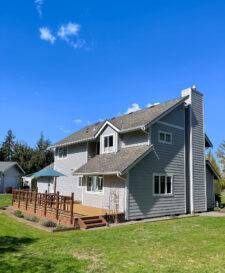
What Wind, UV, Rain, and Salt Air Actually Do to Siding Here
Hurricane-Force Wind
Wind load isn't just about whether siding stays attached in a major storm, though that matters. It's also about the constant lower-grade wind stress that flexes panels, works at loose seams, and tests every fastener year-round. A siding system that isn't rated and installed correctly for hurricane-force wind exposure shows that weakness at the seams and corners first, long before an actual named storm arrives.
Wind-Driven Rain
Straight-down rain is easy for almost any siding to shed. Rain that's being driven sideways by wind is a different problem, because it gets pushed into laps, seams, and trim lines that were only ever designed to handle water moving down, not sideways or upward. Dunedin's exposure to Gulf weather systems means wind-driven rain is a routine event here, not an occasional one, which puts sustained pressure on every flashing detail and joint in a wall system.
Near Year-Round UV
Florida gets some of the most intense UV exposure in the continental United States, and in this part of the state it stays high across nearly the entire calendar rather than concentrating in a short summer window. UV breaks down caulk and unstabilized finishes, chalks and fades paint film, and accelerates the wear on any material that depends on a field-applied coating for its weather protection.
Salt Air
Salt-laden air moving in off the Gulf accelerates corrosion in exposed metal — fasteners, flashing, trim — and that process runs continuously, not just when a storm rolls through. A corroding fastener loses holding strength over time and can open a small gap where it penetrates the siding, which is exactly the kind of entry point that gets worse rather than better the longer it sits.
Why We Install Only James Hardie Siding in Dunedin
Given what those four stresses do to a wall over time, the material underneath the finish matters as much as the finish itself. Wood-based and engineered-wood siding products absorb moisture into their fiber structure, and in a climate that alternates between saturating rain and intense sun within the same day, that wet-dry cycling happens more often and more abruptly than in a milder region — which is what drives the swelling, cupping, and edge delamination those products are prone to over time. Vinyl doesn't absorb water the same way, but it isn't dimensionally stable under heat and direct sun, and its seams and J-channels create their own places for wind-driven rain to collect.
James Hardie fiber cement is made from cement, sand, and cellulose fiber, cured into a dense board that doesn't swell and shrink with humidity the way wood-based products do. That dimensional stability doesn't make it immune to problems — the caulk joints, fastener lines, and cut edges around any fiber cement installation still have to be detailed correctly, every time — but the base material itself isn't the moisture-absorbing weak point that pushes maintenance costs up year after year. That's the standard we hold every Dunedin installation to, and it's why we don't offer LP SmartSide, vinyl, Cemplank, Allura, primed spruce, or cedar as alternatives.
The Hardie Product System, Not Just a Board
James Hardie siding is a manufactured system, and two parts of that system matter specifically for homes in this climate.
HZ5 Climate Engineering
James Hardie manufactures regionally-specific formulations rather than one universal product. Homes in our part of Florida receive the HZ5 line, engineered for high-humidity, high-moisture-exposure conditions — a different formulation than what's sold in a dry inland climate. It's a manufacturing specification built into the board itself, not a marketing label.
ColorPlus Factory Finish
Rather than being painted on site after installation, ColorPlus finish is baked on in multiple coats under controlled factory conditions. It resists fading and chipping substantially better than field-applied paint holds up under near year-round UV, which matters most on the trim edges, corners, and seams that catch direct sun and rain from different angles throughout the day.
Product Lines Available
| Product | Profile | Common Use |
|---|---|---|
| HardiePlank | Horizontal lap siding | Standard full-elevation siding on most home styles |
| HardiePanel | Vertical panel siding | Board and batten look, full walls or accent sections |
| HardieShingle | Staggered or straight-edge shingle profile | Coastal cottage and craftsman-style accents |
| HardieTrim | Trim boards and battens | Corners, window and door surrounds, fascia |
| HardieSoffit | Vented and non-vented panels | Eave and overhang protection, attic ventilation |
What a Correct Installation Involves
Hardie siding performs the way it's engineered to only when it's installed to the manufacturer's fastening, gapping, and flashing specifications. A correct job on a Dunedin home includes:
- A continuous, properly lapped water-resistive barrier behind the siding, with no gaps or reversed laps
- Correct panel gapping at butt joints and terminations, matching James Hardie's published clearances for our climate zone
- Flashing installed in the correct sequence with the house wrap at every window, door, and wall penetration
- Corrosion-resistant fasteners at the type, spacing, and depth suited to a coastal, salt-exposed environment — not the minimum a manufacturer allows in a generic climate
- Sealed and primed cut edges wherever James Hardie's instructions require it
- Correct clearance between the bottom of the siding and grade, decking, or roof lines, so the material isn't sitting in standing water after heavy rain
None of these steps are unique to Hardie as a brand — they're the difference between a siding job that shrugs off storm seasons and one that starts showing seam and flashing failures within a few years, regardless of what material is underneath.
How the Job Actually Runs
- Walkthrough and assessment — we look at the existing siding, wall assembly, and any problem areas (rot, moisture staining, prior repairs) before quoting anything
- Scope and estimate — a written scope covering material, prep work, and any repairs the existing sheathing or framing needs before new siding goes on
- Tear-off and inspection — removing the old siding gives us a direct look at the sheathing and water-resistive barrier, which is often the first time hidden moisture damage becomes visible
- Weather barrier and flashing — house wrap and flashing installed and sequenced correctly before a single piece of siding goes up
- Hardie installation — panels, planks, or shingles installed to manufacturer fastening and gapping specs, sized to Dunedin's wind exposure
- Trim, caulking, and final detail work — corners, window and door surrounds, and the specific joints where James Hardie calls for sealant
- Final walkthrough — reviewing the finished work with the homeowner before calling the job complete
Cost Factors for a Dunedin James Hardie Project
| Factor | Why It Moves the Price |
|---|---|
| Tear-off and disposal | Removing existing siding, especially multiple layers or damaged material, adds labor and haul-away cost |
| Sheathing or framing repair | Rot or moisture damage found during tear-off has to be addressed before new siding goes on |
| Product line and profile | Lap siding, board and batten, and shingle profiles carry different material and labor costs per square foot |
| Trim and detail complexity | Homes with more corners, gables, dormers, and window trim take more labor per square foot than a simple rectangular elevation |
| Home height and access | Two-story walls and limited access around the property add equipment and labor time |
| ColorPlus vs. field-applied finish | Factory-finished ColorPlus costs more up front but removes a repaint cycle from the maintenance schedule |
We don't publish a flat per-square-foot number because these factors genuinely change the total, and a number that ignores them isn't useful to a homeowner trying to plan a project. A walkthrough gives an honest, specific estimate instead.
Why Hiring a Crew That Already Works Dunedin Matters
Installation quality is the single biggest factor in how long any siding system actually lasts, and that's especially true in a coastal Pinellas County setting where the margin for error is smaller than it is inland. A crew that regularly works Dunedin homes already knows what this specific stretch of coastline does to a wall assembly — how much wind exposure to plan for on a Gulf-facing elevation, how aggressively salt air corrodes an under-specified fastener, and where wind-driven rain tends to find weak flashing first. That's not knowledge you get from a general contracting background; it comes from doing this work, on this coastline, repeatedly.
It also matters for licensing and follow-through. Florida requires proper contractor licensing for exterior work, and a crew based in and working this area is easier to hold accountable if a warranty question comes up years down the road, compared to an out-of-town crew that isn't coming back through regularly.
Maintenance Expectations After Installation
One of the practical advantages of a correctly installed Hardie system in Dunedin is what it removes from a homeowner's to-do list. Realistic upkeep looks like:
- An occasional rinse to clear salt residue, pollen, and general grime, especially on Gulf-facing walls
- A visual check after major storms for any loosened trim, caulk separation, or shifted flashing
- Keeping irrigation and landscaping from spraying directly onto the base of the siding
- Touch-up limited to areas with actual physical damage, not a routine repaint cycle
There's no annual caulk-and-repaint maintenance cycle to manage, and the material isn't feeding termites or absorbing humidity between rain events the way wood-based siding can. That's a meaningfully lighter maintenance load than most alternatives in this climate.
Getting Started
If your Dunedin home's siding is aging, showing storm damage, or you're planning a re-side and want it done with a material and installation approach built for what this coastline actually does to a wall, we're happy to take a look. Reach out below for a free, no-pressure estimate.