 Oldsmar Siding
 Why Safety Harbor's Position on the Bay Changes What Siding Has to Do
Safety Harbor sits right on Old Tampa Bay, which puts homes there in a slightly different exposure category than houses a few miles inland in Oldsmar or elsewhere in Pinellas County. Waterfront and near-waterfront properties catch more direct wind, more salt-laden air, and more sustained UV reflecting off open water. None of that is exotic — it's just physics — but it does mean the siding on a Safety Harbor home is working harder, year-round, than siding on a home set back from the water. Fiber cement is one of the few common siding materials built to handle that combination without the moisture and fastener problems that show up faster in this kind of environment.
This page is specifically about fiber cement siding for Safety Harbor properties — not a general overview of siding options, and not the story for Oldsmar broadly. If you own a home in this pocket of Pinellas County, here's what the climate actually asks of your siding, what a correct fiber cement installation looks like, and why the details matter more here than they would somewhere fifty miles inland.
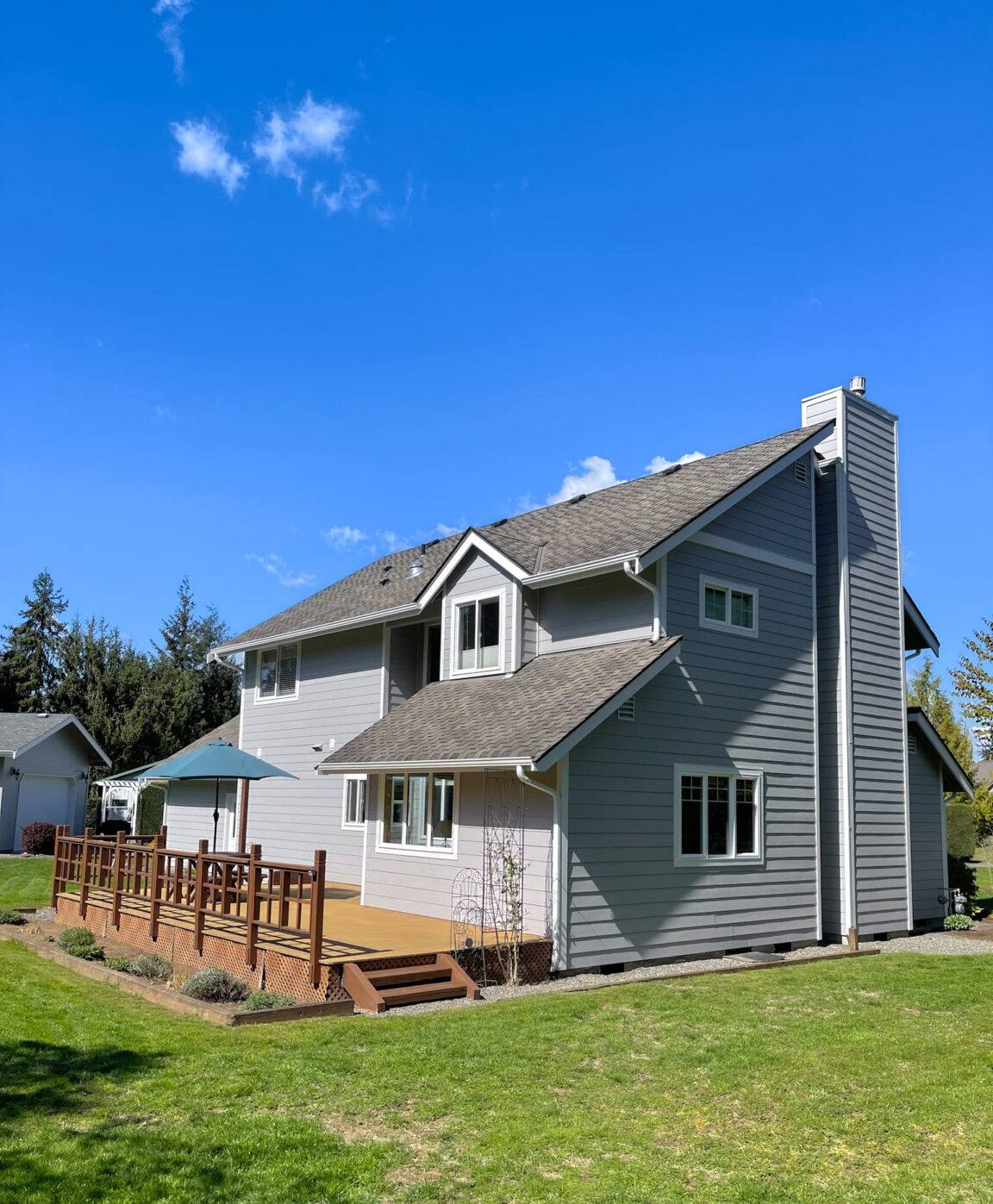
What Safety Harbor's Climate Actually Puts Siding Through
Wind-Driven Rain
Straight-down rain is easy for almost any siding to shed. Wind-driven rain is a different problem — it hits the wall at an angle and gets forced into laps, seams, and trim lines that were never designed to handle water moving sideways. Safety Harbor's exposure to open water means gusts off the bay can push rain into a wall assembly with more force than a sheltered inland lot sees on the same storm day, and hurricane season brings sustained wind events where every seam and penetration in the siding gets tested at once.
Nearly Year-Round UV
Florida's UV load is among the most intense in the continental U.S., and open water nearby only adds to it through reflected glare. UV breaks down caulk and sealants, fades unstabilized paint finishes, and speeds up the drying half of every wet-dry cycle a material goes through. A finish that isn't engineered for this level of sun exposure will visibly age faster on a Safety Harbor home than the same product would inland or in a milder climate.
Salt Air Off the Bay
This is the factor that separates Safety Harbor from a lot of the rest of Pinellas County. Salt-laden air moving off Old Tampa Bay accelerates corrosion in anything metal — fasteners, flashing, trim — and that process runs continuously, not just during storms. A fastener that starts corroding loses holding strength and can open a small gap where it penetrates the siding, which becomes a direct water entry point that gets worse over time. Fastener choice and flashing detail matter more here than they would on a comparable home twenty minutes inland.
Why We Install James Hardie and Nothing Else
We are a James Hardie-only contractor. We don't install LP SmartSide, vinyl, Cemplank, Allura, primed spruce, or cedar, and that's a deliberate professional standard, not a sales position. Each of those alternatives has real strengths — LP SmartSide and cedar are worth acknowledging on the merits — but they also carry trade-offs in moisture behavior, installation sensitivity, or long-term maintenance that we don't think hold up well against a bay-adjacent Florida climate over a couple of decades. Engineered wood products, including LP SmartSide, are wood-based and can be vulnerable at cut edges and fastener penetrations if moisture gets in and isn't caught early. Cedar and primed spruce are solid wood, which means they absorb and release moisture with every wet-dry cycle — a cycle that repeats far more often here than in a drier region, and each cycle is a small opportunity for swelling, checking, or paint failure. Vinyl doesn't absorb water the way wood does, but it isn't dimensionally stable in heat and direct sun, and its seams and J-channels create their own places for water to collect.
James Hardie fiber cement is a mix of Portland cement, sand, and cellulose fiber, engineered specifically for high-moisture, high-UV climates through its HZ5 product line built for this region. It's non-combustible, dimensionally stable across temperature swings, and finished with the factory-applied ColorPlus coating, which is baked on and UV-stabilized rather than field-painted — a real advantage in a climate where UV is working against a finish nearly every day of the year. Hardie also backs its siding with a strong transferable warranty when it's installed to their specifications, which matters on a coastal property where you want a warranty that actually reflects real-world conditions, not a mild-climate assumption.
What a Correct Fiber Cement Job Involves
Fiber cement is only as good as its installation. The material itself resists moisture and holds up to wind and UV, but nearly every real-world failure we see traces back to a detail that was skipped or done out of sequence, not to the siding itself. On a Safety Harbor home, we pay particular attention to:
- Correct clearance between the bottom of the siding and grade, roofing, decks, and patios, so water doesn't wick up into the cut edge of the board
- Flashing installed in the right sequence with the water-resistive barrier, especially around windows, doors, and any wall penetration, so water is directed out and down rather than trapped behind the siding
- Corrosion-resistant fasteners — stainless steel or hot-dip galvanized, rated for the fastener schedule Hardie specifies — given how much faster ordinary fasteners corrode in salt air off the bay
- Proper fastener placement and depth, driven flush without overdriving, which affects both the siding's wind resistance and its ability to shed water at the nail line
- Factory-cut edges kept intact wherever possible, and any field cuts sealed with a Hardie-approved touch-up product before the piece goes up, since a raw cut edge is the most vulnerable point on the board
- Caulk and sealant only at the joints Hardie specifies — over-caulking traps moisture just as reliably as under-caulking lets it in
- Panel and board gapping sized correctly for expansion, so the assembly isn't fighting itself as temperatures swing through the day
Every one of those details is more consequential here than it would be on a similar home in a milder, drier part of the country, because Safety Harbor's combination of wind, sun, and salt air gives a marginal installation less time to reveal itself as a problem.
How Fiber Cement Compares for a Home Like Yours
| Material | Behavior in Wind-Driven Rain | Behavior in Salt Air / UV | Long-Term Maintenance |
|---|---|---|---|
| James Hardie fiber cement | Dimensionally stable; performance depends on correct flashing and fastener detail | Non-combustible, factory ColorPlus finish resists fading and chalking | Periodic caulk and fastener checks; no repainting cycle with ColorPlus |
| Vinyl siding | Seams and J-channels can collect wind-driven water | Can warp or fade under sustained sun and heat | Low upkeep but limited lifespan in intense sun |
| Engineered wood (LP SmartSide) | Vulnerable at cut edges and fastener points if sealant fails | Wood-based; moisture cycling is the main long-term risk | Requires vigilant caulk and paint maintenance |
| Cedar / primed spruce | Absorbs water; swells and contracts with each wet-dry cycle | UV and salt air accelerate checking and finish breakdown | Regular repainting and sealing on a recurring schedule |
Our Process for a Safety Harbor Project
We start with an in-person inspection of the existing siding and, where it's exposed, the condition of the sheathing and water-resistive barrier underneath, because what's happening behind the wall matters as much as what's visible from the street. From there we walk through material and color options within the Hardie lineup, explain the fastener and flashing plan for your specific exposure — a house closer to the water gets more attention to fastener spec than one set back — and give you a clear, written scope before any work starts. During installation, we sequence flashing and the water-resistive barrier correctly rather than just fastening boards over whatever is already there, because that sequencing is where most long-term failures start. When the job is done, we walk the property with you and cover what routine maintenance looks like going forward.
Why a Crew That Already Works Safety Harbor Matters
A contractor who mostly works inland jobs can install fiber cement competently and still miss the details that matter specifically on bay-adjacent homes — the fastener upgrade for salt exposure, the extra attention to flashing on a wall that takes wind-driven rain more often, the clearance details that matter more when a house sits close to the water. A crew that regularly works in Safety Harbor and elsewhere along Pinellas County's shoreline has already seen what happens when those details get skipped, and builds them into the job by default rather than as an afterthought. That familiarity doesn't show up as anything dramatic — it shows up ten years later, in siding that's still doing its job.
What to Expect After Installation
Correctly installed James Hardie siding is genuinely low-maintenance, but "low-maintenance" isn't "no-maintenance." A quick homeowner checklist for a bay-adjacent property:
- Rinse salt residue off the siding periodically with a garden hose, especially on walls facing the water
- Do a visual check of caulk lines at trim, windows, and doors once or twice a year, and after any major storm
- Keep an eye on fastener heads for early signs of corrosion or staining
- Trim back landscaping that holds moisture against the wall or blocks airflow along the siding
- Address any impact damage from debris promptly, since a damaged panel left exposed gives water a way in
None of that requires special equipment or a contractor visit in most cases — it's the kind of upkeep that keeps a correctly installed system performing the way it was designed to for decades.
What This Costs and What Drives the Range
Fiber cement siding costs more upfront than vinyl and is generally in a similar range to quality engineered wood systems, though the exact number for your home depends on square footage, the amount of trim and detail work, how much of the existing siding and sheathing needs to be removed and inspected, and the Hardie product line and finish you choose. We don't publish a flat number because two houses of the same size can price very differently once you account for corners, window and door count, and the condition of what's underneath the existing siding. What we can tell you upfront is that a correct installation — the flashing, the fasteners, the clearances — is not the place to cut cost on a home exposed to bay wind and salt air, because that's exactly where a cheap installation shows its weaknesses first.
If you're weighing siding options for a Safety Harbor home, we're happy to take a look and give you a straightforward, no-pressure estimate — what your home actually needs, what it would cost, and why. Reach out through the form below to get started.